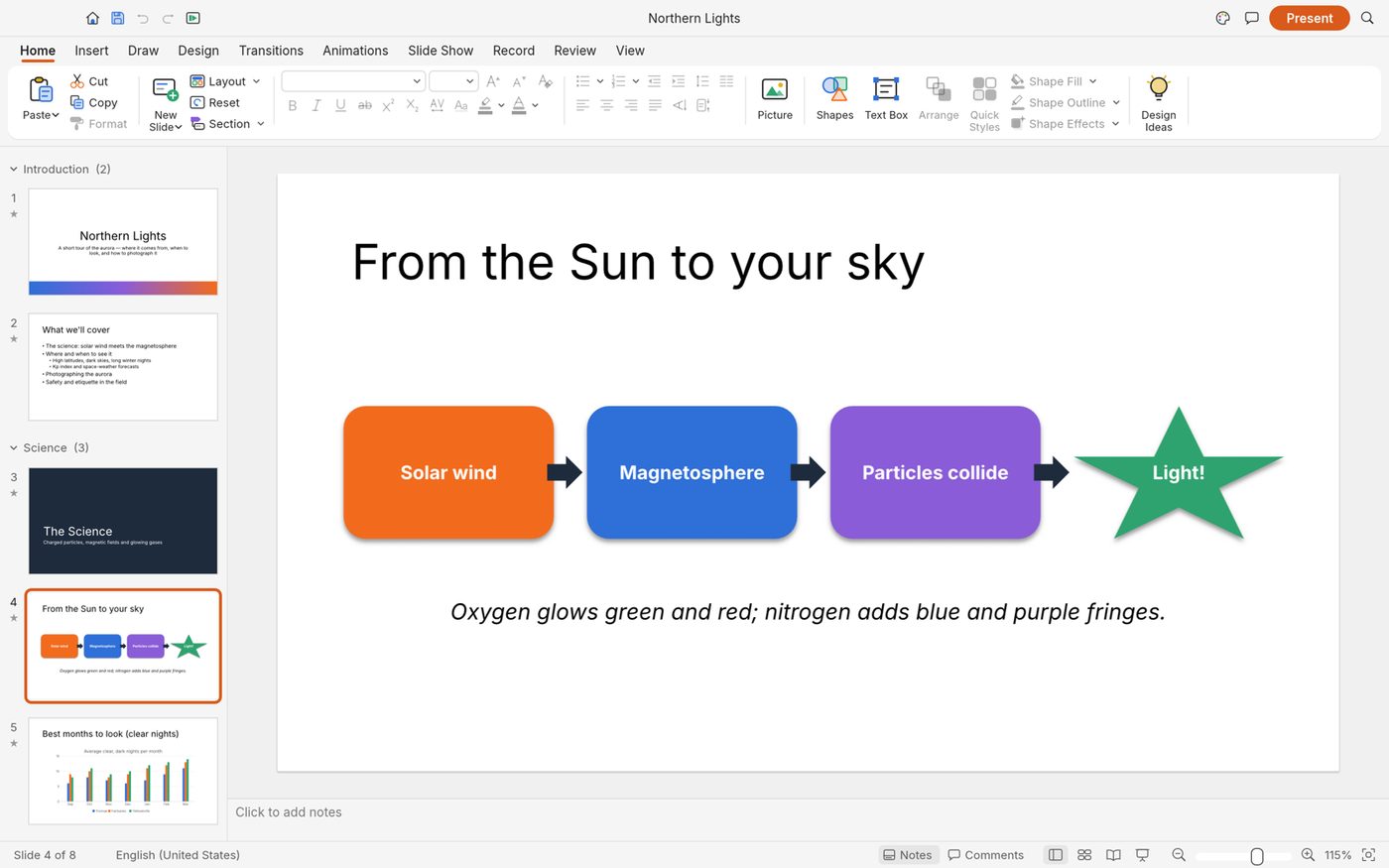
The best demonstration that these are real applications rather than concept art: slide masters, themed layout inheritance, boolean shape merges, Morph, rehearse timings. It is also the one whose gaps are least visible from a screenshot — a deck can look perfect and still round-trip badly through .pptx.
What it claims, and how it measures it
DeckCraft measures itself with cargo xtask parity against a 191-item checklist of PowerPoint features, weighted into three priority tiers. The result: 84% breadth overall, with 92% of the P0 (core) items, 82% of P1 and 55% of P2.
Then it grades itself down. Ready for real work is ~55%, a mainstream presenter gets ~53%, and an essentials user ~62%. The gap between 84% and 55% is the same gap that runs through this whole family: a feature that exists is not a feature that holds under a real file and a real deadline.
What actually works
- Slide craft — masters, eleven layouts with placeholders that inherit position and formatting, eight original themes with colour and font schemes, sections, notes, comments.
- Drawing — 150+ preset shapes with adjust handles, connectors glued to shapes, freeform and curve tools, boolean merges (union, combine, fragment, intersect, subtract), gradient and picture fills, glow, soft edges, reflections.
- Motion — transitions including Morph, entrance/emphasis/exit and motion-path animations, by-paragraph builds.
- Presenting — full-screen show, presenter view, pen, rehearse timings, media playback.
- Media — audio in MP3, AAC, FLAC, ALAC, Ogg, Opus, WAV and AIFF; video in H.264, HEVC, VP9 and AV1.
- Export — .pptx read/write, PDF (slides, notes pages, handouts with selectable text), PNG/JPEG, and an animated GIF of the deck.
226 commands and 28 dialogs are exposed as stable, addressable ids — which is why the same verbs work from the GUI, the CLI, a JSON control channel and the MCP server.
What doesn't work yet
Confirmed working
- Masters, layouts, themes, notes
- Shapes, connectors, boolean merge
- Morph and animation builds
- Presenter view, rehearse timings
- .pptx read/write, PDF/PNG/JPEG/GIF export
Documented gaps
- .pptx round-trip losses on real decks
- EMF/SVG import and embedded fonts
- Legacy .ppt and .odp support
- Video export; GPU raster; hardware decode
- Localisation in 11+ languages
The roadmap puts the remaining work at 120–210 agent-hours to beta and 340–600 to full parity, with the largest single block being .pptx exchange — a real-deck corpus, round-trip losses, EMF/SVG, embedded fonts.
Two details worth knowing
First, the CLI can save a native .deckcraft file, an extension the README mentions once and never explains. If you plan to script DeckCraft, find out what that format is before you build a workflow on it, or stay with .pptx.
Second, this is a Linux build that needs ALSA headers for show audio; without alsa-lib-devel (Fedora) or libasound2-dev (Debian), the build stops at alsa-sys. Fonts come from a companion craft-fonts repository, or your system fonts if it is absent.
Should you install it?
Try it if you build decks from scratch, want vector-clean PDF export, or want an agent to generate slides from structured data. Building a deck in DeckCraft and exporting PDF is a defensible workflow today.
Wait if your deck has to go to a client who will edit it in PowerPoint. Round-trip losses are the project's own number-one remaining cost, and "looks right" is not "opens right".
Sources: github.com/storytold/deckcraft (README, ROADMAP.md, docs/parity-checklist.md, docs/gaps.md), read 18 October 2026.